
SEVERN CLINICS PAIN · INJURY · RECOVERY
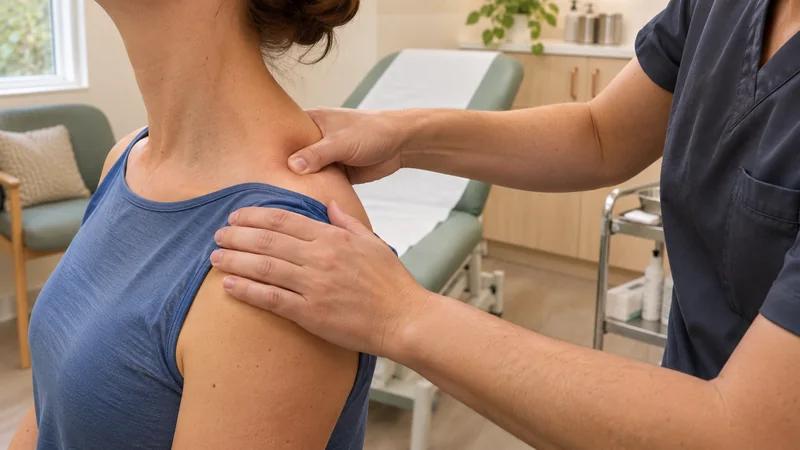
Illustrative clinical scene of targeted thumb pressure at a seated patient’s upper shoulder in a warm treatment room.
Severn Clinics · Wellington CBD

Myofascial Trigger
Point Therapy

Targeted muscle pressure for pain and musculoskeletal care in Wellington

If you've ever pressed on a painful spot in a muscle, or had someone press one for you, you already know what a myofascial trigger point is.

At Severn, we use careful examination and anatomical knowledge to find sensitive muscular points that may be relevant to your symptoms. Sometimes pressure on one particular spot recreates the exact pain you've come to see us about.

A closer look at the treatment

Myofascial Trigger Point Therapy at a Glance

Targeted manual pressure

We use fingers, thumbs and occasionally elbows to apply controlled pressure to selected muscular points, often for 10–30 seconds.

Recognisable pain patterns

Pressing a sensitive muscle can sometimes recreate your familiar pain, even when you feel that pain somewhere else.

25-minute appointments

We usually combine trigger point work with other suitable treatments, adjusting the approach according to your examination and response.

Understanding the anatomy

What Does Myofascial Mean?

Myo means muscle. Fascia is the connective tissue that surrounds, separates and links muscles with other structures.

Together, the term myofascial refers to muscles and their associated connective tissues.

A trigger point is the name given to a particularly sensitive area within a muscle, sometimes felt within a band of tension. Applying pressure may cause local tenderness or reproduce pain felt elsewhere.

It's a useful clinical concept, not a guarantee that every painful spot has one identifiable cause.

MUSCLECONNECTIVE TISSUE
A history of clinical curiosity

A Brief History of
Myofascial Trigger Points

In the 1930s, American physician Janet Travell experienced shoulder and arm pain. While examining the muscles around her own shoulder blade, she pressed a tender spot and was surprised to feel her familiar arm pain return.

Her curiosity became part of a much wider scientific investigation into muscle pain. Travell later worked with physician David Simons, whose research helped document the patterns clinicians were observing.

They brought attention to something familiar to hands-on pain clinicians: pressure on a muscle can reproduce pain in a different anatomical location from the point being pressed.

Researchers around the world have investigated myofascial pain for decades. One bibliometric study identified more than 1,000 research papers on myofascial pain syndrome published between 1956 and 2022.

Pressure and Referred Pain
Simplified layers of skin, fascia and muscle, with the area of clinical pressure indicated. This illustration does not depict a visible trigger point or a verified referral mechanism.Simple tissue cross-section showing an area of pressure over the skin, fascia and muscle.
Pain and referral patterns help us target where to work.
Pain and the nervous system

When Pain Refers

Referred pain is a well-documented and experimentally reproducible feature of human pain physiology. Scientists have demonstrated that stimulating a muscle can produce pain felt beyond the muscle itself.

What remains less certain is exactly how these sensations arise, why they vary between people and how reliably any particular tender point can be identified as the source of someone's symptoms.

But there's a more practical question for you:

Could a sensitive point in a muscle be contributing to the pain you're experiencing?

A website can't answer that. A careful examination can give us clues, particularly if pressure reproduces familiar symptoms. We then look at what happens when we treat the area, rather than assuming the first tender point we find is responsible.

Choosing when to use it

When Do We Consider
Trigger Point Therapy?

We consider it when your symptoms and examination suggest that sensitivity within a muscle may be relevant to your pain.

Our knowledge of anatomy and experience with commonly observed referral patterns guide where we examine. We palpate selected muscles, looking for tenderness, tension and, most importantly, whether pressure recreates a sensation you recognise.

That might mean examining an area some distance from where you feel the pain.

We also consider joints, tendons, nerves and other possible sources of similar symptoms. The aim is to make a thoughtful clinical choice, not to label every sore spot a trigger point.

Ask us about trigger point therapy →
Illustrative clinical scene of targeted thumb pressure at a seated patient’s shoulder in a room with light timber furnishings.
Careful manual pressure, with the intensity guided by the patient · illustrative image
Your appointment, step by step

What Happens During an Appointment?

01

Finding the relevant point

We discuss your symptoms and examine the area with our hands. You tell us whether the pressure feels locally tender or produces pain you recognise.

02

Applying controlled pressure

We use a finger, thumb or occasionally an elbow to hold pressure on a selected point, commonly for 10–30 seconds. We adjust the force carefully and talk with you throughout.

03

Working at the right intensity

You're usually lying comfortably on the treatment table, sometimes sitting. We vary the location and pressure according to what you feel. Occasionally, dry needling may be considered instead of, or alongside, manual pressure. We discuss that separately and only proceed with your agreement.

04

Rechecking your response

We reassess pain, tenderness and movement, then consider whether the result supports continuing with that approach. Appointments are generally 25 minutes, with trigger point work often combined with other suitable treatments.

What it feels like

What Does Trigger Point Therapy Feel Like?

This is one of the more distinctive sensations in hands-on treatment. When pressure reaches a particularly sensitive point, it can create a deep, concentrated ache. Occasionally it reproduces your familiar pain with surprising accuracy.

In our clinical experience, almost all patients describe this as “good pain” when the intensity is right: strong, but manageable, and often strangely satisfying.

Getting that intensity right depends on careful communication. We don't force the pressure or expect you to tolerate unnecessary discomfort. Some muscular soreness or aching afterwards is possible.

Careful communicationComfort guides the pressure
25-minute appointmentsOften combined with other care
Checking what really matters

What Matters Is
Your Response

Finding a point that recreates your pain is interesting. What happens afterwards is more important.

We check whether your symptoms, tenderness or movement change after treatment. Then we ask what happened over the next day or two, including whether any improvement lasted.

Sometimes the response gives us a good reason to continue. Sometimes it doesn't.

If treating a particular point produces no worthwhile change, we question whether that muscle is an important contributor and consider other possible explanations rather than repeatedly applying pressure to the same spot.

Reproducing your pain helps us choose where to start. What happens to your pain afterwards tells us whether that choice was worthwhile.

What guides our next step?
The examination
gives us a clue.
01
Did pressure recreate familiar pain?An observation worth exploring
02
Did your symptoms change?We reassess the pain that matters to you
03
Should the treatment change?Continue, adjust or consider other causes

Your response helps determine what happens next.

Come and look around

Take a Look
Around Severn

See our Wellington clinic and treatment rooms before your first appointment.

Watch Our Clinic Introduction →
Still from the Severn Clinics introduction video.
Real people, real conversations

The People Behind Severn

The people you'll meet at our Wellington clinic.

TH
Tobias HallView profile →
KC
Kade ChristensenView profile →
ZM
Zabad MichaelView profile →
Useful to know

Questions About Myofascial Trigger Point Therapy

Will it hurt?

The pressure can feel intense, particularly at sensitive points. We aim for a manageable sensation and adjust it in response to your feedback.

Why might you press somewhere other than where I feel pain?

Muscular pain can sometimes be felt at a different location. We use anatomy and examination to explore that possibility without assuming it explains every symptom.

How long do you hold the pressure?

Usually around 10–30 seconds for an individual point, depending on the area and your response.

Is a needle involved?

Usually not. We primarily use manual pressure. If dry needling seems appropriate, we discuss it with you first.

Will I be sore afterwards?

Temporary muscle tenderness or an aching sensation is possible.

Do I need to book trigger point therapy specifically?

No. Tell us about the pain or injury and we'll help arrange an appropriate appointment.

Watch Our Clinic Introduction

Watch on YouTube