SEVERN CLINICS PAIN · INJURY · RECOVERY
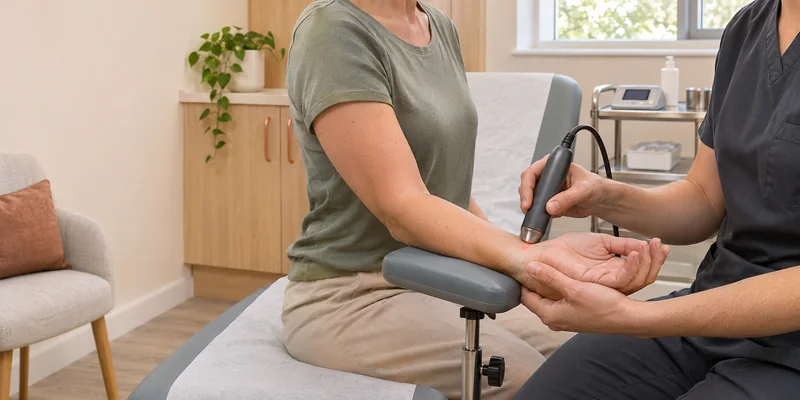
Illustrative clinical scene of laser treatment at a patient’s wrist, with light oak cabinetry and a paper-covered examination couch.
Severn Clinics · Wellington CBD

Laser
Therapy

High-power and low-level therapeutic laser in Wellington.

Laser therapy uses concentrated light that penetrates deep beneath the skin.

At Severn, we use both high-power and low-level laser. We often consider laser when an examination suggests inflammation may be contributing to pain. Which system we choose, and how we apply it, depends on the area involved and the clinical findings.

A closer look at the treatment

Laser at a Glance

◎

Two types of laser

Both are available at Severn. They differ in power, treatment settings and how quickly they deliver energy.

◷

20–25-minute appointments

Laser application itself usually takes no more than 10 minutes. Our appointments are longer because they generally involve a combination of treatments.

◌

Often a pleasant experience

Many patients find the application relaxing, with a comfortable warmth being the most common sensation.

A surprising medical history

A Medical Discovery
Nobody Expected

From cutting tissue to studying how light interacts with it

When lasers entered medicine in the 1960s, the primary focus was on their ability to concentrate energy so precisely that surgeons could cut or remove tissue.

Then, in 1967, Hungarian surgeon Endre Mester noticed something entirely different. In experiments with laboratory mice, he reported faster hair regrowth in animals exposed to low-powered laser light.

This result raised a new question: could light interact with living tissue in a way that was actually beneficial to the body's processes?

That question helped give rise to photobiomodulation, a field exploring how particular wavelengths of light interact with biological processes.

What started as an unexpected observation developed into decades of research into the ways light impacts living tissue.

1960
The first working laser is demonstrated
1967
Endre Mester reports an unexpected biological observation
Today
Light–tissue interaction remains an active field of medical research

Clinical selection

When Do We
Use Laser?

Inflammation is part of the body's response to injury and can contribute to some painful musculoskeletal problems. When your history and examination suggest that inflammatory activity may be involved, laser is one of the approaches we consider.

We're always interested in the nature of the problem, which tissues may be involved, and what has or hasn't changed with previous care.

We use that information to decide whether laser deserves a place in the treatment plan.

Ask us about laser →

SKINTISSUE BELOW
Illustrative anatomy · not to scale
Understanding the science

How Does Laser
Therapy Work?

More than warmth

Therapeutic lasers use selected wavelengths of red or near-infrared light. As light passes through the skin, some is absorbed or scattered. A portion can reach tissue beneath the surface.

Researchers have investigated how absorbed light interacts with living cells. One intriguing laboratory finding involves mitochondria, the parts of cells that produce much of their ATP, a molecule used to transfer energy. Certain light exposures have increased ATP production in experiments.

These light–cell interactions are studied in photobiomodulation. The warmth you feel during a session is only one part of the experience; the cellular science is more complex.

An observed cellular effect in research is no guarantee of clinical benefit for every painful condition in the real world. In fact, far more research is needed before we understand the full scope of what laser can and cannot do for different pain conditions.

01Light enters tissue
SKIN BELOW THE SKIN

Some light reaches beneath the surface. Along the way, tissue absorbs and scatters it, so less energy reaches deeper areas.

02Researchers study cell responses
MITOCHONDRION

In laboratory experiments, certain light exposures have changed cellular activity, including ATP production in mitochondria.

Simplified research illustration, not to scale. Laboratory findings do not predict an individual patient's treatment result.

Two ways of working

Two Laser Systems.
Two Ways of Working.

Why Severn uses both

01 / Low-Level Laser

Low-Level Laser

Low-level systems deliver small amounts of energy and generally produce little noticeable heat. They have a long history in photobiomodulation research, and we continue to use low-level laser at Severn.

We used it extensively for years. Our clinical experience was less convincing than the research had led us to hope, and that prompted us to explore another approach.

02 / High-Power Laser

High-Power Laser

High-power systems deliver more energy in a shorter time, with different options for settings and application. Wavelength and delivery technique still matter.

Our clinical experience since introducing high-power laser has been considerably more encouraging. We now favour it in many situations, while continuing to use both systems.

Our preference comes from clinical experience, not proof that higher power is better for every condition. The illustrations compare output conceptually, not treatment depth or effectiveness.

What to expect

What Happens During
Laser Treatment?

A few minutes in the treatment room

01

We assess the area.

We discuss your symptoms, examine the relevant region and explain why laser is being considered.

02

You get comfortable.

You normally sit or lie on the treatment table. We prepare the area and follow the necessary safety procedures, including appropriate eye protection.

03

We apply the laser.

A handheld applicator, rather like a small torch, directs light towards the selected area. We check how it feels and adjust the application when needed.

04

We reassess your response.

Straight after the application, we reassess your pain and movement, including whether you've noticed any immediate relief. As with any treatment, laser won't work for everyone.

Inside the treatment room

What does laser therapy feel like?

One of the distinctive things about laser is how often patients enjoy it. In our experience, many describe a pleasant, relaxing warmth. Some say it feels as though the warmth is coming from within the treated area. Others notice a little tingling or almost nothing at all.

Those sensations describe the experience, not how deeply light has penetrated or whether the treatment will work. If the warmth becomes uncomfortable, we adjust or stop.

20–25 minutesTypical overall appointment*
Up to 10 minutesUsual laser application

*Appointment duration reflects reported clinic practice and should be confirmed before publication.

Reviewing treatment

We Look for a
Meaningful Response

We monitor your pain levels closely and look carefully for signs that the treatment is working.

We want to know how you feel after the appointment, whether any change lasts, and whether you notice soreness or another unwanted reaction.

Your response helps us decide whether to continue, change the approach or consider something different.

Talk to Severn →
How we judge the response
What actually changed?
01
PainLess, more or about the same?
02
MovementDoes anything feel different?
03
TimeDid a change last beyond the visit?

That tells us more than simply repeating another session.

Come and look around

See Severn
Before You Visit

Take a look around our Wellington clinic and get a feel for the treatment environment.

Watch Our Clinic Introduction →
Still from the Severn Clinics introduction video.
Real people, real conversations

The People Behind Severn

Meet the people behind assessment and treatment decisions at Severn.

TH
Tobias Hall
Chiropractor
View profile →
KC
Kade Christensen
Sports therapist
View profile →
ZM
Zabad Michael
Physiotherapist
View profile →
Useful to know

Questions About Laser Therapy

Is this the same as surgical laser?

No. Surgical and therapeutic laser systems share the physics of laser light, but their purposes and settings differ. Severn uses non-surgical therapeutic laser.

Does high-power mean better treatment?

Not automatically. We favour it in many situations based on clinical experience, but the evidence varies by condition and protocol.

Will I need several sessions?

That depends on your problem and your response. We review whether further sessions are worthwhile rather than prescribing a fixed course for everyone.

Can I ask about laser without booking it specifically?

Yes. Tell us what is troubling you. We'll help determine the right appointment and discuss whether laser is worth considering.

Watch Our Clinic Introduction

Watch on YouTube