
 04 385 6446
01 / hands-on mobilisation
Hands-on mobilisation
We use our hands to apply pressure and carefully move the skin and underlying soft tissues in different directions. The amount of force depends on the area and how sensitive it feels.
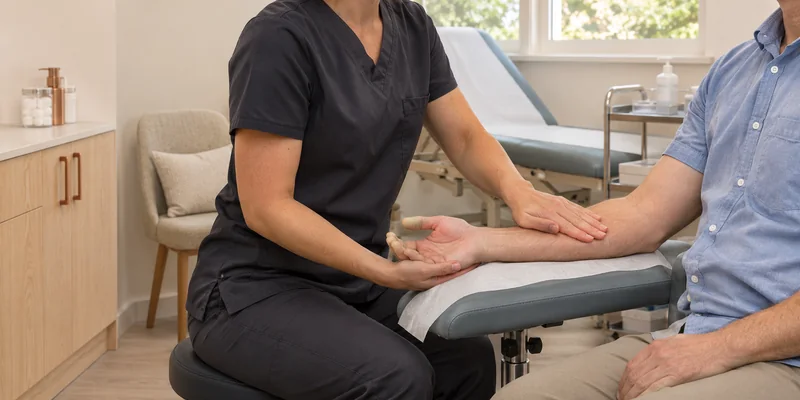
When an area feels tight, tender or difficult to move, the explanation isn’t always in the muscle or joint itself. The connective tissues around them deserve attention too.
At Severn, we examine how skin, fascia and underlying muscles move against one another. We choose how to work with those tissues, then pay attention to your response.
We use manual pressure, smooth-edged instruments and guided stretches, selecting techniques to suit the anatomy and sensitivity of the area.
Fascia surrounds and connects the body’s structures, contains sensory nerves and helps neighbouring tissues move in relation to one another.
We often combine fascial release with other suitable treatments during your appointment, depending on your symptoms and examination findings.
For a long time, fascia was treated almost as packaging: something to move aside to reach the muscle or joint underneath.
When Tobias Hall trained, it received surprisingly little attention. Years of clinical practice and new research changed his thinking.
Fascia is a network of connective tissue. It surrounds muscles, forms strong sheets around the back and limbs, and connects structures that move together without moving identically.
Crucially, it’s also sensitive tissue.
In a revealing 2014 experiment involving twelve healthy volunteers, stimulating lower-back fascia produced more sustained and widespread pain than stimulating the underlying muscle.
That doesn’t establish that fascia causes any particular patient’s back pain. But it demonstrates why overlooking it makes little anatomical sense.
Layers that work together, without moving identically
When you bend, reach or turn, your soft tissues don’t move as one solid block. Different layers stretch, transmit tension and slide against their neighbours.
Between some fascial layers is hyaluronan, a substance that helps them glide. These arrangements vary from the lower back to the shoulder, hip and forearm.
That’s why we consider how tissue moves under our hands, not just whether a muscle feels tight.
A sensitive or less-mobile area, however, doesn’t prove that fascia is stuck or responsible for the pain.
Fascial layers and the tissues around them are mechanically connected. The illustration is schematic, not a diagnostic image or proof of a particular pain mechanism.
Fascial release describes a range of techniques designed to influence the tension, sensitivity and movement of the body’s connective tissues.
At Severn, we use controlled pressure, gliding movements, smooth-edged instruments and stretching to work with areas that feel unusually tight, tender or restricted.
The intention is to help an area become more comfortable and move more freely.
We select the technique according to the anatomy, the sensitivity of the tissues and what we find during examination. Then we reassess.
For us, the important question isn’t simply whether the tissues feel different under our hands. It’s whether that difference translates into a worthwhile change for you.
We consider fascial work when examination suggests that tissue sensitivity or restricted movement might be relevant to your pain.
We look at how the skin and superficial tissues move from side to side over deeper structures, alongside your movement and any recognisable tenderness.
The lower back, back of the shoulders and hips are common areas in our experience, but fascial tissues exist throughout the body.
There is no simple blood test or routine scan that can reliably tell us that a particular palpable restriction is the cause of your pain. Our findings are clues, not a definitive diagnosis.
Ask us about fascial therapy →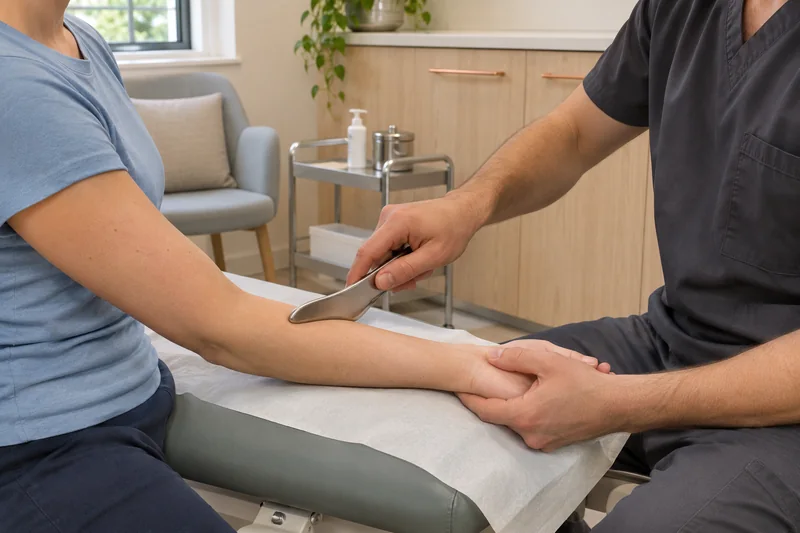
Hands, instruments, stretching and moving suction
We use our hands to apply pressure and carefully move the skin and underlying soft tissues in different directions. The amount of force depends on the area and how sensitive it feels.
Smooth-edged handheld tools, including Graston-type and gua sha techniques, allow us to apply controlled gliding pressure across selected areas. The contact can feel more concentrated than treatment with the hands.
We may guide a movement or sustained stretch while asking you to relax into the tension. Muscles and fascia are connected, so stretching rarely isolates one tissue.
Occasionally, we move a suction cup across the skin to apply a different direction of force. This overlaps with our vacuum cupping work and is chosen selectively rather than used in every session.
We discuss your symptoms, examine movement and assess tenderness and soft-tissue glide.
We explain whether hands-on mobilisation, an instrument or a stretch is worth considering. You may be lying down or sitting. Work around the hands, arms and neck is often easier while seated.
Treatment may involve firm pressure, a gliding sensation across the skin or a deep stretch. We adjust the intensity as we go. You don’t need to endure excessive discomfort.
We reassess movement, tenderness and how the area feels. Appointments are generally 25 minutes, and fascial release is often combined with other appropriate treatments.
People sometimes describe the pressure or stretch as a kind of good pain: intense, but manageable.
Some techniques feel like broad pressure moving across the surface; others create a deeper stretching sensation. More superficial, sensitive areas can feel sharper or less comfortable.
Temporary tenderness or bruise-like discolouration can follow, sometimes even after relatively gentle treatment. We discuss these possibilities before proceeding and adjust the technique in response to your feedback.
Established anatomy and treatment effects are different questions
Fascia’s anatomy and sensory innervation are increasingly well studied. Whether particular techniques improve pain is a separate question.
A 2026 review of 20 randomised trials involving 1,420 people reported improvements in pain and range of motion with instrument-assisted soft-tissue mobilisation. Results for function were less consistent, and the studies varied in methods and conditions.
These findings don’t establish that an individual’s pain comes from a fascial adhesion, or that treatment breaks one apart. Nor can results for instruments automatically be applied to every hands-on or stretching technique.
One observation has shaped the way we use fascial work: sometimes an area feels noticeably more mobile after treatment, but the patient’s pain hasn’t changed.
That’s useful information.
If movement improves but your pain doesn’t, our suspicion shifts away from fascia as the main contributor to your symptoms.
We then investigate other possibilities, including muscles, joints, tendons and nerves, rather than repeatedly treating a tissue that doesn’t appear to be responsible for the pain.
Conversely, when someone does notice a positive change, we want to know whether it lasts and makes a meaningful difference to daily life.
We judge a treatment’s value by the patient’s response, not just by what we can feel through palpation and examination.
A better sensation under our hands is useful. Your own experience is the deciding factor.
See our Wellington clinic and treatment rooms before your first appointment.
Watch Our Clinic Introduction →
The people you'll meet at our Wellington clinic.
There is overlap. Both can involve pressure and movement through soft tissues. At Severn, we select hands-on techniques, tools or stretching according to the examination and what we want to reassess.
We don’t assume that a tender or less-mobile area contains a specific adhesion. Nor can we verify that a hands-on technique has physically broken one apart.
It can feel firm or intense, especially in sensitive areas, but we keep the treatment within your tolerance.
Sometimes. Temporary skin redness, tenderness or bruise-like discolouration can occur, even after relatively gentle work.
Not necessarily. We consider your symptoms, medical history, skin condition and comfort before recommending a technique.
No. Tell us about your pain or movement problem and we’ll help arrange the appropriate appointment.