
 04 385 6446
Gentle and adjustable.
We use controlled movements around a joint, changing the pressure and range according to your comfort and response.
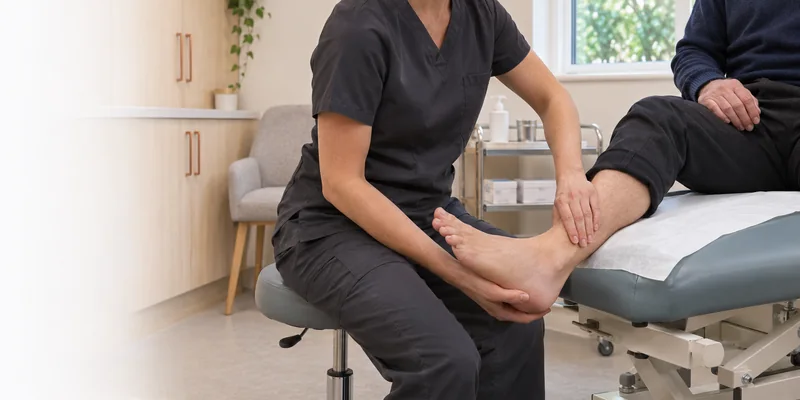
With all the technology available to treat pain today, it is easy to overlook one of the oldest tools in musculoskeletal healthcare: a skilled pair of hands.
At Severn Clinics, manual joint mobilisation remains an important part of our work. Gentle, controlled movements can be used when a joint is painful or difficult to move. We choose the technique and intensity according to your assessment, how you respond and what you feel comfortable with.
The goal is straightforward: to help with your pain and movement, without doing more than your body needs.
We use controlled movements around a joint, changing the pressure and range according to your comfort and response.
We assess whether manual joint mobilisation is appropriate, rather than treating every painful joint in the same way.
When useful, hands-on joint care can sit alongside exercise, rehabilitation or other treatments available at Severn.
The terms are sometimes used interchangeably, but they describe two different approaches.
A practitioner uses their hands to guide a joint through controlled movements, often in a gentle, repeated rhythm. The range, pressure and speed can be changed throughout treatment. Some movements are barely noticeable; others feel like a firmer stretch. The aim is to work with the joint at a level you can tolerate.
A practitioner delivers a brief, carefully directed movement to a joint, usually at a much higher speed. It may produce a familiar clicking or popping sound, but a sound is not required. Manipulation is a distinct technique, used only when the assessment, relevant risks and the patient's preferences make it a suitable choice.
Neither technique is about putting bones back into place. A click does not mean that a joint has been corrected, and it is never our measure of whether treatment has worked.
This page is about manual joint mobilisation, rather than the separate soft-tissue and fascial treatments we also provide.
Hands-on approaches to joints have been used for thousands of years. In earlier centuries, people often sought help from traditional bonesetters. Today, related techniques are used by appropriately trained physiotherapists, osteopaths and chiropractors.
Manual joint mobilisation is, by definition, performed by hand. A practitioner can feel how a joint moves, notice how you respond and adjust the movement immediately. That direct contact is a large part of its value.
Modern technology has given us more options for treating pain, including laser and shockwave therapy. But a machine is not automatically a better choice than a well-delivered hands-on technique.
Manual joint mobilisation and manipulation also have a place in international clinical guidance for selected back pain presentations, generally within a broader approach to care. We regard hands-on work as part of modern healthcare, not an alternative to it.
First, we assess the painful joint and consider your symptoms, medical history, previous treatment and any reasons a particular movement might be unsuitable.
You may be sitting, standing or lying down, depending on the area being treated. We explain what we're going to do and make sure you're comfortable proceeding.
Our approach is to start low and go slow. We begin with gentle, carefully controlled movements and adjust as we learn how the joint responds. You may feel a light rocking movement, a stretch or some pressure around the area. You should always tell us if something feels uncomfortable.
The hands-on work itself may take only a few minutes. At Severn, it often forms part of a longer appointment, commonly around twenty minutes, during which we may use other treatments if appropriate.
We don't keep applying more force simply because a joint feels stiff. Your comfort and response help determine what happens next.
Far from it. Only a very small proportion of our patients receive joint manipulation.
We carefully screen and select patients, taking account of both their preferences and how their condition is likely to respond. Someone who dislikes the idea of a rapid movement, especially around the neck, will not be pressured into it.
For most people receiving hands-on joint care, slower manual joint mobilisation is a more relevant option. And sometimes neither technique is appropriate.
Manipulation has its own risks and suitability considerations. Techniques involving the neck need particularly careful screening, explanation of risks and alternatives, and informed consent. We would rather choose a different approach than perform a technique simply because it's familiar.
A painful joint may be only one part of the picture. You may also have an irritated muscle, a demanding work routine or reduced strength after an injury. Manual joint mobilisation doesn't have to address all of those issues by itself.
We may use it alongside exercise advice, rehabilitation or another treatment such as laser or acupuncture, depending on the assessment. These aren't fixed combinations or extras that everybody needs.
Sometimes hands-on joint care is the main focus of a visit. Sometimes we use it briefly to help someone move more comfortably before working on longer-term strength and function.
Just as importantly, we reassess. If repeated mobilisation isn't helping, we reconsider the approach rather than carrying on out of habit.
Some people report feeling more comfortable or moving more freely after treatment. Others notice little immediate change. Neither response tells the whole story, so we look at how your pain and movement change over time.
Temporary soreness or stiffness can occur, occasionally for a day or two. We explain what to expect and what should prompt you to get advice.
After an initial session, we may suggest easing off unusually heavy or strenuous activity for a short period. The advice depends on your problem and the treatment you've received.
The important question isn't whether a joint clicked, or how much pressure was applied. It's whether the treatment was appropriate and is helping you get back to normal activity.
It is usually well tolerated, although a sensitive joint may feel uncomfortable with certain movements. We begin gently and adjust the pressure, range and position according to your response.
No. It is a technique, not a profession. Appropriately trained chiropractors, physiotherapists and osteopaths may all use forms of manual joint mobilisation.
Usually not. Rhythmic manual joint mobilisation generally doesn't involve the rapid movement associated with a click. A noise is not necessary for useful treatment.
Absolutely. We will never insist on a technique you're uncomfortable with. We can discuss other options and whether they suit your condition.
It may be an option for some neck or back problems, depending on the diagnosis and individual risks. An assessment helps us decide whether it belongs in your treatment plan.
No. We use it when there's a good clinical reason, and only with your agreement. Another treatment or rehabilitation approach may be more appropriate.
If you're dealing with back pain, neck pain or a joint that feels stiff and uncomfortable, we can assess what's happening and discuss the options.
You don't need to decide in advance whether manual joint mobilisation is right for you. We'll help you work that out.