
 04 385 6446
01 / Acupuncture
Acupuncture
Traditional acupuncture draws on a broader system of treatment points and clinical reasoning, sometimes including points distant from the painful area.
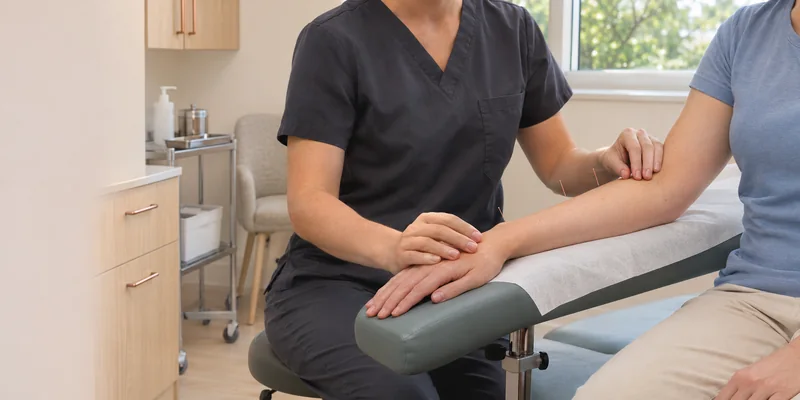
At Severn, we use detailed anatomical knowledge and careful palpation to identify points that reproduce your familiar pain.
These findings help us decide where, and whether, to use acupuncture or dry needling. The aim is to identify meaningful targets precisely, rather than simply placing needles in the general area of discomfort.
 4.9 · 400+ Google reviews
We carefully examine muscles and surrounding tissues, looking for points that reproduce recognisable pain.
Many needle insertions cause little sensation. Sensitive points can feel sharper, so we monitor your comfort throughout.
Needling may be combined with other appropriate treatments during your visit.
Therapeutic needling has been practised in Chinese medicine for more than 2,000 years. Traditional acupuncture developed into a broad system of treatment points and clinical reasoning extending well beyond musculoskeletal pain.
Dry needling developed much later, largely through research into muscular pain, trigger points and referred pain.
Both approaches commonly use similar fine needles. The differences lie in the reasoning behind their placement and, often, the locations selected.
Dry needling is particularly focused on identifying and targeting painful muscles and other tissues. Traditional acupuncture draws from a much wider network of treatment points, including locations that may be some distance from the painful area.
There is considerable overlap between the techniques.
At Severn, we use selected acupuncture points and dry-needling techniques within musculoskeletal care, while recognising that traditional acupuncture is a much broader discipline.
We most often consider needling in three situations.
When an area contains tight or guarded muscles, particularly where pressing specific points reproduces familiar pain.
When the most sensitive points are close to the surface, potentially involving superficial fascial tissues.
When pressure applied in one location recreates pain somewhere else. The place where you feel pain isn't necessarily where we would consider placing a needle.
We use our knowledge of anatomy, careful palpation and the wider examination to select possible treatment points. Reproducing familiar pain is useful clinical information, although it doesn't necessarily prove that a particular point is the sole cause.
Ask us about needling →A surprisingly complex question
Despite thousands of years of acupuncture practice, we still don't fully understand how needling influences pain.
In fairness, that isn't unusual in medicine. Even the precise pain-relieving mechanism of paracetamol, one of the world's most familiar medications, remains incompletely understood.
That doesn't mean scientists have discovered nothing.
Research has shown that needling can stimulate sensory nerves and interact with surrounding tissues. Scientists are also investigating how these interactions influence the nervous system's processing of pain signals.
What remains uncertain is exactly how these responses combine to influence pain in real patients, and why some people respond much better than others.
It's an intriguing area of research, with important discoveries already made and plenty of questions still unanswered.
How acupuncture and dry needling are generally distinguished
Traditional acupuncture draws on a broader system of treatment points and clinical reasoning, sometimes including points distant from the painful area.
Dry needling is particularly focused on identifying and targeting painful muscles and other tissues, informed by anatomical findings.
At Severn, we use selected acupuncture points and dry-needling techniques within musculoskeletal care. The approaches overlap, and the individual treatment decision still matters.
We carefully examine the painful area with our hands, looking for points that recreate your recognisable symptoms. Anatomical knowledge helps us understand the structures beneath the skin and select appropriate targets.
We explain the proposed needling technique, check suitability and ask for your consent. You'll usually lie comfortably on your back or front, depending on the area involved. We use fine, sterile, single-use needles.
We often begin with shallow insertion to assess your tolerance, adjusting the depth and technique when appropriate. We monitor your comfort closely and avoid unnecessary pain. You can ask us to adjust or stop at any point.
After removing the needles, we reassess your pain, tenderness and movement, looking for any immediate changes. Some people report relief straightaway. Others notice little or no change. Your response helps inform our decision about whether needling is worth continuing.
In our experience, many needle insertions cause little or no sensation. People are sometimes surprised to discover that a needle has already been removed.
At a particularly sensitive point, you might feel a brief prick, dull ache or short muscular twitch. Occasionally, there's a sharper sensation that passes quickly. We pay careful attention to your comfort and adjust the technique accordingly.
Temporary soreness or a bruised feeling can follow treatment, particularly after an early session. Mild bruising or bleeding is also possible. We explain relevant risks and aftercare before proceeding.
If you'd prefer not to have needles, that's absolutely fine. We can discuss other options.
As with all healthcare interventions, needling certainly doesn't work for everyone.
One of the things we value about needling is that, in our clinical experience, we can often gather useful information about a patient's response relatively early.
We monitor pain levels, tenderness and movement, both immediately afterwards and over the following days.
If there's no positive response, we prefer to recognise that early. It allows us to change direction and consider trying other treatments that may work better for you.
An immediate improvement doesn't guarantee lasting results. Equally, redness, soreness or a muscular twitch isn't proof that treatment has worked.
What matters is whether you're experiencing a worthwhile change.
If there's little reason to continue, we would rather recognise that early than repeat a treatment by default.
Researchers analysed 20,827 patients across 39 randomised trials. They found that acupuncture performed better than sham acupuncture and no-acupuncture controls for several chronic pain conditions, including musculoskeletal pain, osteoarthritis and headaches.
The difference compared with sham acupuncture was statistically significant but relatively modest. The difference compared with no acupuncture was considerably larger.
The World Health Organization issued a conditional recommendation in favour of needling therapies, including acupuncture and dry needling, as part of care for chronic primary low back pain. It rated the supporting evidence as low certainty.
Not all authorities agree. The UK's NICE guidelines recommend against acupuncture for low back pain, and against acupuncture or dry needling for osteoarthritis.
Fifty reported findings favouring dry needling, but 57 were judged to have a high risk of bias. The authors concluded that firm conclusions about its clinical effectiveness could not yet be drawn.
The mixed research findings reflect something familiar in our clinic: some people report substantial relief after needling, while others notice no meaningful change.
That variation isn't unique to needling. People respond differently to healthcare interventions generally. The important question is how much responses vary, and how reliably we can identify who is likely to benefit.
Research still has a long way to go before we can answer that confidently. Our clinical experience helps us decide when needling is worth considering, assess the response and change direction early if it isn't helping.
See our Wellington clinic and treatment rooms before your first appointment.
Watch Our Clinic Introduction →


BHSc (Paramedicine) · EMT · Sports Therapy

Doctor of Physiotherapy · NZPA
They use similar needles and sometimes overlapping points, but come from different clinical traditions and approaches to selecting treatment locations.
Not necessarily. Sometimes pressing one area reproduces pain elsewhere. We use that information alongside the wider examination.
Temporary soreness, tenderness or a bruised feeling is possible, particularly after an early session.
Of course. We explain why we're recommending needling and discuss alternatives.
No. Tell us about the problem and we'll help arrange the appropriate appointment.